
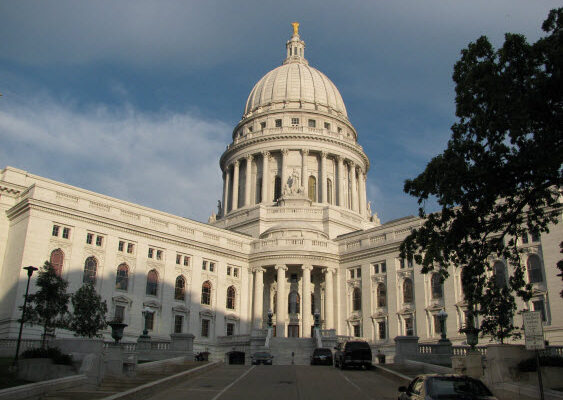
The Wisconsin Legislature was back in session in January 2026 prompting a flurry of activity. Three constitutional amendment resolutions were approved, and proposals to provide tax relief are moving forward. With divided government shaping the agenda, Republicans in the Legislature have moved their priorities while tensions with Democratic Governor Tony Evers continue. Against that backdrop, both chambers advanced a series of high‑profile constitutional amendments to bypass Gov. Evers’ veto. Two of the resolutions to amend Wisconsin’s Constitution received final approval for the second time, as required by the state Constitution and will be placed on the statewide ballot in November, while the third awaits final approval in the Assembly.
Perhaps the most important of these proposed amendments, SJR 116, would restrict the governor’s partial veto authority by prohibiting its use to create or increase taxes or fees. The measure is a direct response to Gov. Tony Evers’ 2023 use of his line-item veto to remove single digits from the state budget to unilaterally extend a school spending increase for 400 years. As a result, property taxes in the state will continue to go up without being authorized by the legislature and governor during the traditional budget process. While the veto itself didn’t directly raise taxes, by increasing the limit annually for 400 years, Evers left the door open for school boards to raise taxes each of those years. Senate Republicans pushed through the amendment to rein in executive overreach and limit the impact of future tax increases. Once approved by the Assembly, SJR 116 will be sent to voters to decide in November.
The next amendment, AJR 102, seeks to eliminate diversity, equity, and inclusion (DEI) programs across state and local government by prohibiting preferential treatment or discrimination based on race, sex, color, ethnicity, or national origin in public employment, education, contracting, and administration, with the goal of restoring fairness and merit‑based decision‑making.
The third measure, AJR 10, would prohibit the state from ordering the closure of places of worship during a declared emergency. Introduced in response to actions taken during the COVID‑19 pandemic, the proposal passed with little debate and will also be on the November ballot.
Beyond the constitutional amendments, with an anticipated budget surplus, Republican proposals to align state law with the federal income taxes cut in last year’s One Big Beautiful Bill by cutting taxes on overtime and tips, among other changes, are gaining traction. While Gov. Evers expressed support for a no tax on tips change earlier in the legislative session, he has not committed to signing the bill and numerous Democrats voted “No” on passage in both the Assembly and Senate. The overtime proposal is more expensive but has made some progress; it passed the Assembly with bipartisan support and is awaiting a public hearing in the Senate.
Additionally, the Assembly passed a fast‑tracked bill regulating data centers by requiring the Public Service Commission to shield ratepayers from additional utility costs related to the facilities, mandating that renewable energy sources serving data centers be located on‑site, placing requirements on water usage and requiring a bond sufficient to cover and required reclamation with the DNR.
With less than two months to go and multiple constitutional amendments now headed to voters, the Legislature’s January activity signals several contentious weeks ahead. The last official “general business” day of the 2025-2026 legislative session is March 19, 2026. Legislators are expected to advance numerous administrative rule reforms, which will likely be vetoed by Governor Evers. Negotiations between legislative leaders and the governor’s office will likely focus on increased education funding in exchange for elimination of the 400-year property tax increase, the debate over funding and the future of WisconsinEye, Wisconsin’s public affairs cable network, remains unresolved.